
Friday Write #116
Butterfly goo or UFO crash site? Metaphors for manuscript drafts

Greetings, writers—
It was with some surprise that I realized I had finished kind of a draft of Book B last week. It’s too short (less then 50,000 words still) and too garbled to be an actual draft, but the material is pretty much all there.1
Book A, meanwhile, languishes in its great length and its overstuffed ambition (“I will say everything I have ever thought about writing and art and beauty and being young and growing old, and also marriage and intellectual property and death and Bach and the publishing industry. And also mothers and daughters and—” You get the idea). Who knows how many words it is, and who knows its final shape.
Book A feels like butterfly goo. Book B is a UFO crash site. As strange as these metaphors are, both seem helpful to me.
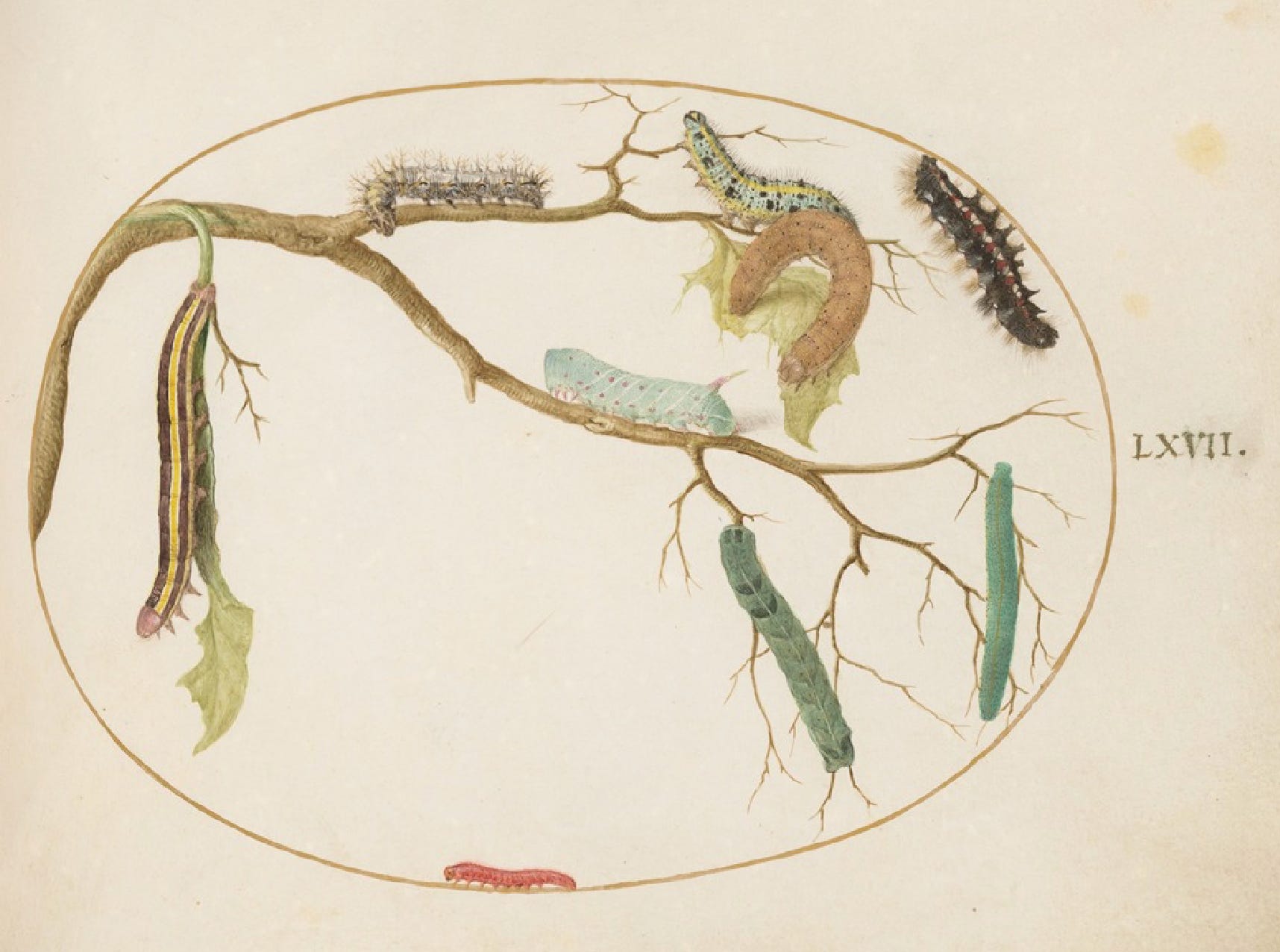
Holometabolous insects—butterflies, bees, ants—actually liquify during the pupal stage. (Horrifying, I know.) This goo is mostly digested larval tissue cells, but somewhere in this soupy mess are tiny sacs of cells that contain the building blocks of the adult insect. These are called imaginal discs.
Imaginal discs! What a perfect name. It’s as if those little discs contain the dream of the adult, with its wings and legs and eyes and antennae (each imaginal disc is responsible for forming a different adult structure). Within a few weeks, thanks to the magic of cell division I guess, voila: what emerges is a perfect, non-gooey adult insect, which you may celebrate or try to poison, depending on its species.
Somewhere in the soup of Book A are the imaginal discs that will form the adult structures of the novel. Do I know what they are yet? Nope, not really. So I will have to go back into the dark soup and find them, inhabit them, and grow them until I can finally hold them up to the light.
It sounds so gross. But it’s reassuring to me, thinking that somewhere in that mess is something solid, something that will one day find its singular, unified form.
As far as UFO crash sites go—well, I’m not going to find the website of a nice nonprofit that gently tells me how that business works, the way I did for butterfly2 metamorphosis. What I can say is this: the draft of Book B is a smoking pile of rubble that seemed to come streaking out of nowhere, and it’s my job to pick up the pieces, polish them, and put them where they need to go3.
I kid you not, when I sit down in front of the draft I sometimes whisper crash site, crash site, like it’s a spell to open the door of the story.
How would you describe your current drafts of things? How might a friend or a writing partner? (It was someone else who told me that Book B was smoking rubble, which she didn’t actually mean as an insult.) In what way might a metaphor help you see the work better—or reassure you about its current state?
I won’t ask you to write about butterflies or aliens, although at least one of those is a familiar subject in poetry4 and could be fun to consider.
Your prompt today is:
Write about something that you can’t see.5
Happy writing,
Emily
The weird thing—which could be exciting or disappointing, depending—is the that the story it tells is not what I set out to write. But that is a topic for another time.
Robert Frost called butterflies “flowers that fly and all but sing.”
An alien considers the “barbarous confusion” of Earth in Robert Hayden’s poem “[American Journal].”
Emily Dickinson wrote a lot of butterfly poems, including Two Butterflies Went Out at Noon and “The Butterfly Obtains.”
You—or your character in whatever you’re already working on!
Love this, Emily! Mine is a bunch of bits of fabric that I’m still collecting and sorting but which may someday become a quilt.
Love this!